

- Emission
- Fuel Supply System
- Measurement & Control
- -
 Eco-friendly Solution
- Customer Service
- Chat Bot
- Service Networks
Customer Support


- About
- Eco-friendly Solution
- MRO
- Customer Support
- Media
- ESG

ESG
- Environmental
Environmental
Environmental Data
Environmental Management
- Environmental Management Strategy
PANASIA is committed to sustainable development through eco-friendly
business practices. To address the global climate crisis, the company
actively works to reduce resource and energy consumption, lower
greenhouse gas emissions, and minimize waste generation.
Based on the ISO 14001 Environmental Management System, PANASIA
has established environmental policies and a structured management
framework to effectively identify, assess, and improve environmental
performance and related risks.


- Environmental Policy and Objectives
Following the principle of prioritizing the environment, PANASIA
operates an environment-centered management system and
carries out various eco-friendly initiatives as part of its commitment
to responsible management.

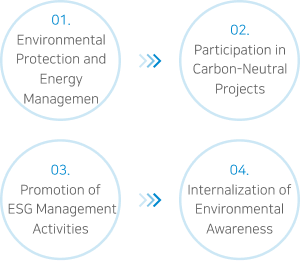
- Environmental Management Framework
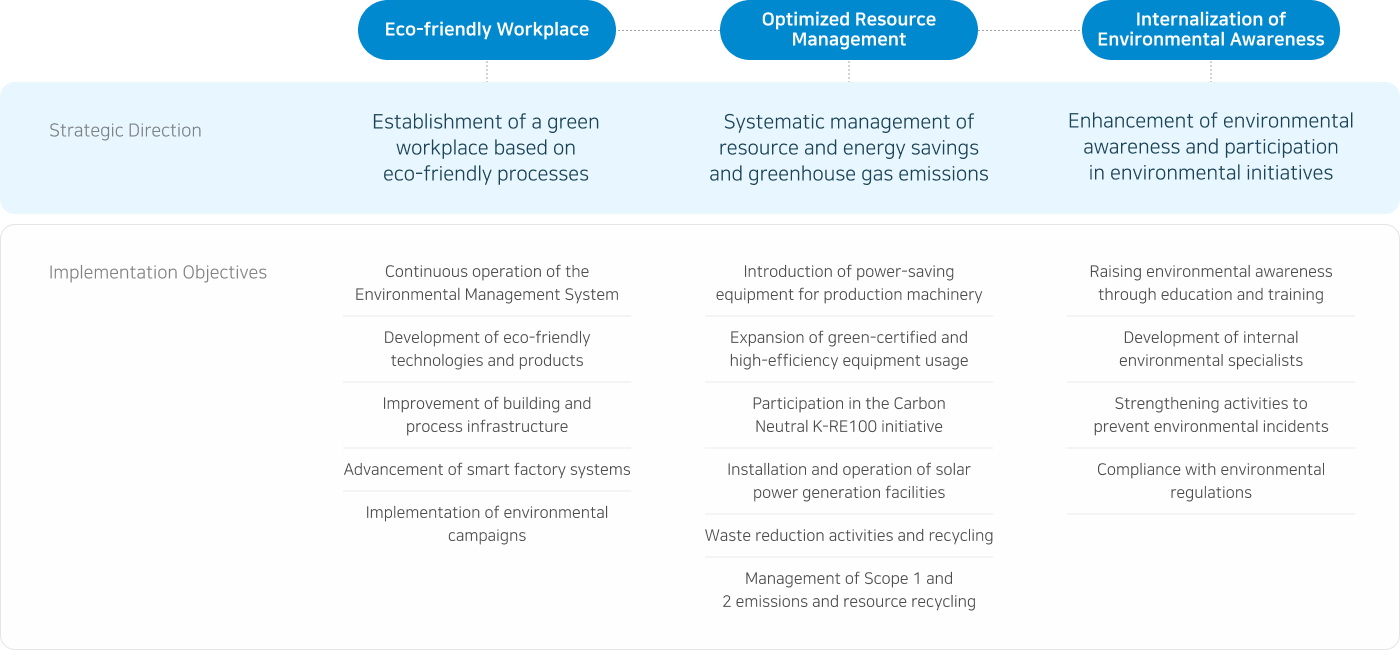


Environmental Goals and Implementation Strategy
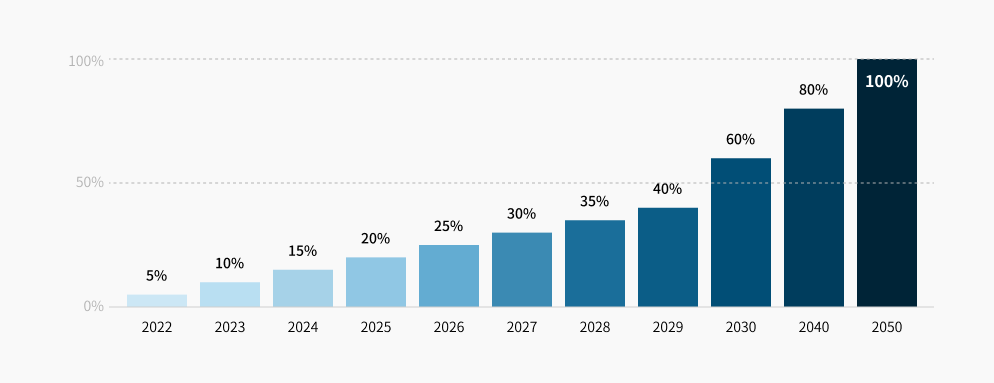
- Greenhouse Gas and Energy Strategy
| Category | Unit | 2022 | 2023 | 2024 |
|---|---|---|---|---|
| Greenhouse Gas Emissions | tCO₂eq | 1,323.14 | 1,538.18 | 1,629.70 |
| Direct Emissions | tCO₂eq | 170.67 | 178.75 | 183.15 |
| Indirect Emissions | tCO₂eq | 1,152.47 | 1,359.43 | 1,446.55 |
| Emission Intensity | tCO₂eq / KRW 100 million | 0.74198 | 0.54813 | 0.61871 |
| Total Energy Consumption* | TJ | 26.58 | 29.86 | 31.72 |
| Energy Intensity | TJ / KRW 100 million | 0.01491 | 0.01064 | 0.01204 |
| Direct Energy Use | TJ | 2.50 | 2.37 | 2.51 |
| LNG | TJ | 1.63 | 1.33 | 1.79 |
| Diesel | TJ | 0.87 | 1.04 | 0.72 |
| Indirect Energy Use | TJ | 24.08 | 27.49 | 29.25 |
| Electricity | TJ | 24.08 | 27.49 | 29.25 |
| Greenhouse Gas Reduction Activity | Implementation Date | Details | Investment (KRW 100 million) |
|---|---|---|---|
| Automated Control System Installation | 2024.09 | Applied automatic control to electrical equipment | 0.03 |
| LED Replacement | 2023.04 | Replaced low-efficiency lamps with high-efficiency LEDs | 0.05 |
| HVAC System Improvement | 2022.08 | Upgraded HVAC equipment and outdoor units | 0.06 |
| Office Window Insulation | 2024.02 | Installed heat-insulating window film in office areas | 0.05 |
| System Air Conditioning/Heating Installation | 2024.05 | Replaced indoor and outdoor units |
To address this, PANASIA plans to identify improvement points through energy audits and strengthen
GHG monitoring via a GHG inventory and smart factory upgrades.
- Renewable Energy
Under the Green Premium Program, PANASIA purchases renewable electricity by paying a premium on existing power rates, as outlined in Regulations on Supporting New and Renewable Energy Facilities (MOTIE Notice No. 2022-175).
Through this program, PANASIA contributes to expanding renewable energy use and realizing green value.
In addition, PANASIA installed and operates a 911 kW solar power system at its headquarters in 2014 and is constructing a 984 kW system at its third plant in 2024, actively utilizing idle spaces to promote the production and supply of eco-friendly energy.
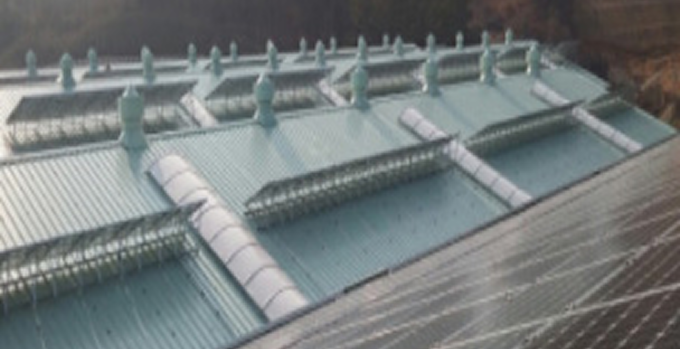
| Solar Power Generation Facility Status | |
|---|---|
| Implementation Period | Since 2014 (ongoing) |
| Total Project Cost | KRW 4,026,000,000 |
| Installation Location | Plant 1 and Plant 3 Sites |
| Installation Area | Approx. 10,040 m² |
| Capacity | 1,895kW |
| Annual Average Power Generation | Approx. 2,800,000 kWh |
However, in Korea, renewable energy adoption remains limited, and available implementation options are fewer.
PANASIA plans to explore multiple approaches recommended under K-RE100, including expanding self-generation, Power Purchase Agreements (PPA), purchasing Renewable Energy Certificates (REC), and equity participation. Additionally,
PANASIA is constructing a solar power facility at its second plant, scheduled to begin operation in the second half of
2025. Moving forward, PANASIA will continue to align with global climate action efforts and work alongside its customers
to advance RE100 participation.
Eco-Friendly Products and Business Models
PANASIA has developed a range of eco-friendly business models based on its proprietary green technologies, applicable across multiple industries.
Key products include Carbon Capture and Storage systems (Pan-CCS™), ammonia and biogas hydrogen extractors, SOx/NOx reduction systems, and water treatment units.
Among these, PANASIA focuses on its Pan-CCS™ system, a technology that directly contributes to achieving carbon neutrality.
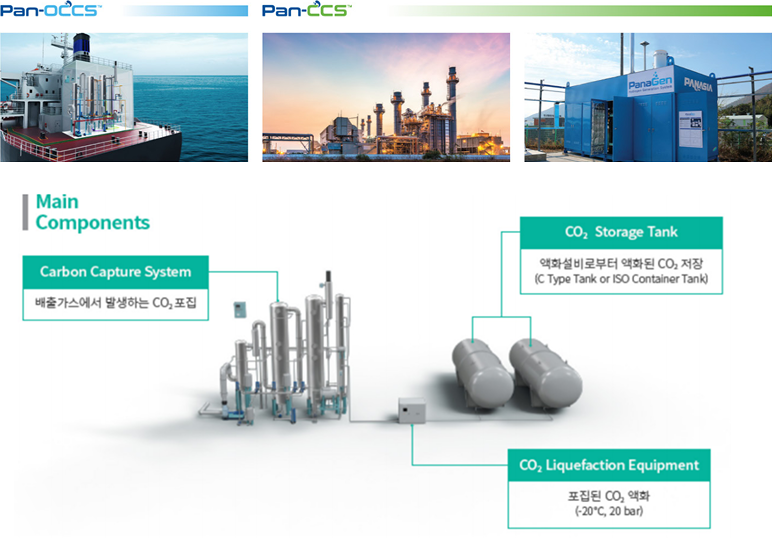
 Pan-CCS™ (Carbon Capture and Storage System)
The Pan-CCS™ system isolates CO₂ emissions from major sources such as ships, power plants, steelworks, and cement factories.
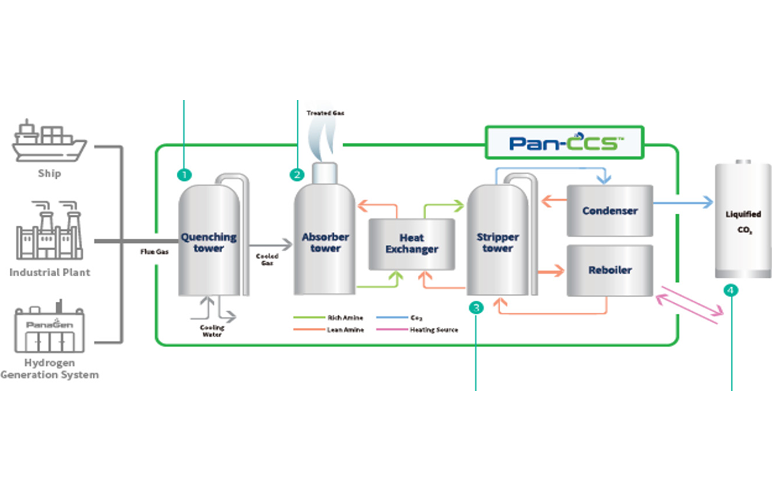 Carbon Capture Diagram
- ① Pre-treatment of Flue Gas The gas is cooled and cleaned of particles and SOx in a quenching tower, then compressed by an intake fan before entering the absorber.
- ② CO₂ Absorption The cooled gas reacts with an amine-based solvent in the absorber, selectively capturing CO₂. High-performance packing and optimized internal design ensure efficient mass transfer.
- ③ Regeneration The CO₂-rich solvent moves to the stripper tower, where heat from the reboiler releases CO₂. Water and CO₂ are separated, with CO₂ sent for liquefaction.
- ④ Liquefaction & Storage The separated CO₂ is compressed, cooled, and liquefied for storage or utilization.
Worldwide, efforts toward carbon neutrality and greenhouse gas reduction are accelerating.
The International Maritime Organization (IMO) enforces regulations on Energy Efficiency Design Index (EEDI) and Carbon Intensity
Indicator (CII) for both new and existing ships, tightening emission standards throughout the vessel lifecycle.
In Korea, policies such as the GHG & Energy Target Management System (2011), Emissions Trading Scheme (2015), and 2050 Carbon
Neutral Declaration have strengthened environmental regulations.
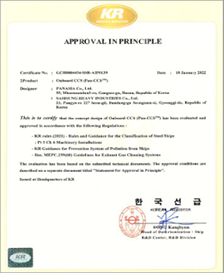
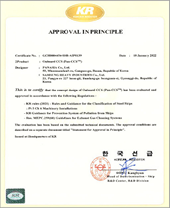
In response, PANASIA developed an integrated Carbon Capture and Hydrogen Extraction Package Solution, becoming the first in
Korea to obtain AIP certification from the Korean Register (KR) in 2022.
PANASIA expects that widespread adoption of these technologies across marine sectors (shipping, shipbuilding) and land-based
industries (power generation, industrial plants) will significantly contribute to carbon neutrality and GHG reduction.
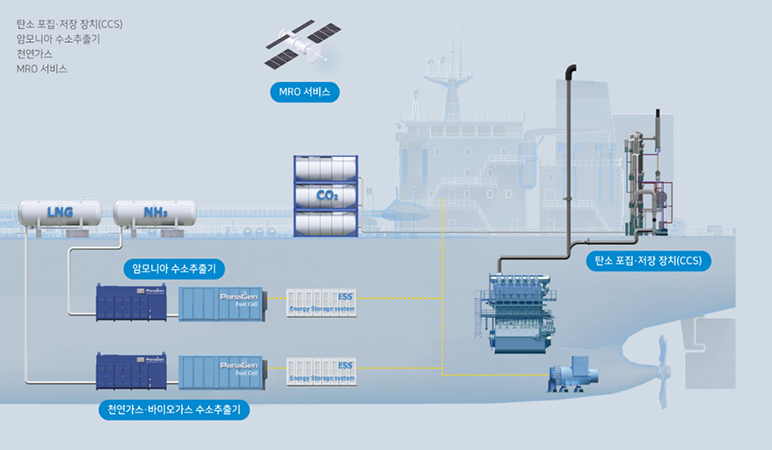 Marine Carbon Neutral Solutions
To help achieve IMO 2050 Net Zero, PANASIA provides technologies such
as CCS systems, hydrogen extractors, and ammonia/methanol fuel supply
systems for ships.
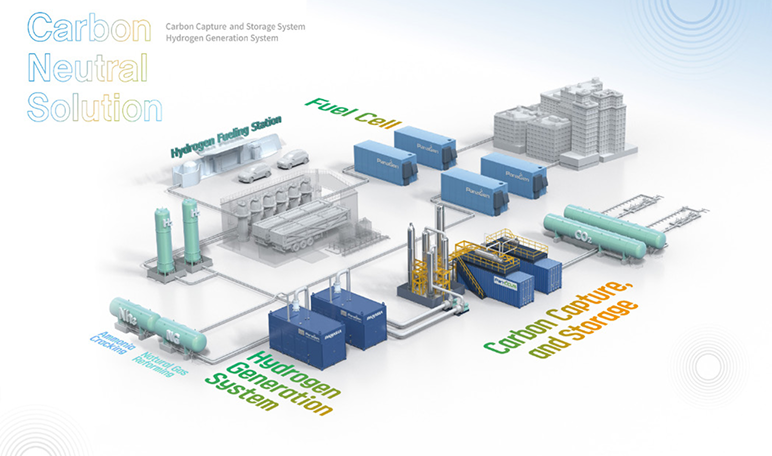 Onshore Carbon Neutral Solutions
To support Korea’s NDC goals, the EU Carbon Border Adjustment
Mechanism (CBAM), and global Net Zero initiatives, PANASIA supplies
technologies for green hydrogen production, offering not only equipment
but also engineering and EPC services.
PANASIA operates an intelligent, human-centered Smart Green Factory, integrating all production stages with ICT technologies to deliver customized, eco-friendly products efficiently. From product planning to design, manufacturing, and service, all processes are digitally connected, ensuring sustainable production and a safe working environment. Moreover, PANASIA enhances customer convenience through innovative solutions such as an Integrated Control System, E-Learning operation manuals, and remote maintenance platforms that extend product lifecycle support.
| Level | On-site Automation | Factory Operation | Resource Management | Product Development | Supply Chain Management |
|---|---|---|---|---|---|
| Advanced | IoT/IoS-based CPS | Internet-based business CPS network collaboration | |||
| IoT/IoS Implementation | IoT/IoS-based diagnosis and operation using big data | ||||
| Intermediate 2 | Equipment control automation | Real-time process control |
Real-time factory management | Simulation and process automation | Multi-product development collaboration |
| Intermediate 1 | Equipment data collection automation | Real-time decision-making | Automated technical data generation and collaboration | Multi-product production collaboration | Multi-product development collaboration |
| Basic | Manual data collection automation | Process flow management | Technology and delivery management via servers | Collaboration with single suppliers | Single parent company dependence |
| No ICT Application | Manual work | Collaboration via phone and email | |||
Smart Factory
A smart factory is a human-centered, intelligent production system that integrates every stage of manufacturing—from product planning to sales—through ICT (Information and Communication Technology).
It covers all manufacturing processes, from design and development to mass production, and includes both application systems and automation/control systems on the factory floor.
Smart factories are classified into five levels, from non-ICT to advanced integration. PANASIA currently operates at the advanced level and continues to enhance and innovate its production systems.
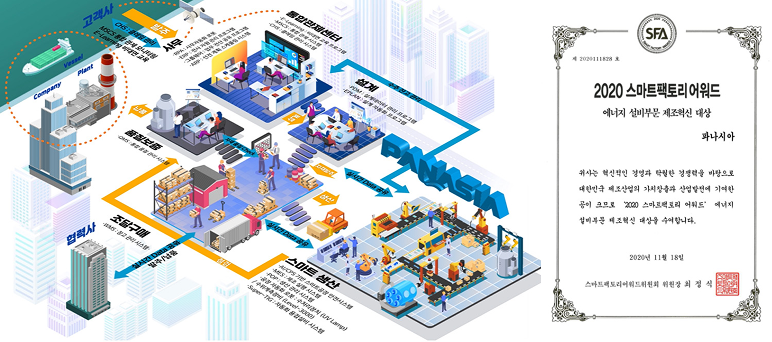 Smart PANASIA
Since 2015, PANASIA has been building and operating its smart factory in phases. Previously, the production of UV lamps—a key component in ballast water treatment systems—required manual processes such as glass molding and heat treatment. Now, the entire process is automated through smart manufacturing systems, resulting in significantly higher productivity and reduced defect rates, improving cost competitiveness. In 2020, PANASIA introduced IoT-based robotic systems for ship-level monitoring equipment, and by 2021, it had completed full implementation of MES (Manufacturing Execution System), WMS (Warehouse Management System), and APS (Automatic Production Scheduling) across all products and processes. As a result, PANASIA became the first company in Busan and the first in Korea’s marine equipment industry to achieve such recognition—earning the Smart Factory Award for Manufacturing Innovation (Energy Equipment Category).
Waste Management
The Facility Management Team oversees proper waste handling, maintaining detailed inspection logs and ensuring compliance with storage duration standards by waste type.
The Facility Management Team supervises operations with participation from subcontractors and relevant departments. When selecting subcontractors, PANASIA prioritizes those with recycling technology and environmental permits.
| Input | ESG Team | Contractor | Output | |
|---|---|---|---|---|
| P (Plan) | Requirements | Review and report expected waste | Contract, report | |
| Contract | Contractor Selection | Contractor compliance monitoring results |
||
| D (Do) | Waste slip | Request waste treatment | Transport and disposal | Waste Treatment Confirmation |
| Generation Record and Registration |
Weighing Report | |||
| C (Check) | Issue occurrence | Daily inspection of waste | ||
| A (Act) | Review and report improvement actions |
Improvement completion report |
generated at its sites. The company is also exploring recycling methods for previously non-recyclable waste such as used
mineral oils, continuously monitoring subcontractors’ disposal practices, and considering recyclability when purchasing
raw materials and consumables.

We seek creative challenges
with our infinite passion for
eco-friendly technologies.


- Panasia About Eco-friendly Solution MRO Customer Support Media ESG
-
Address
55 MIEUMSANDAN 3-RO,
GANGSEO-GU, BUSAN, KOREA
(46744) -
Tel 051 831 1010FAX 070 4369 3701
- Contact Us
COPYRIGHT@PANASIA CO.,LTD. ALL RIGHT RESERVED
