

- Emission
- Fuel Supply System
- Measurement & Control
- -
 Eco-friendly Solution
- Customer Service
- Chat Bot
- Service Networks
Customer Support


- About
- Eco-friendly Solution
- MRO
- Customer Support
- Media
- ESG
Emission
- Eco-friendly Solution
- Emission
- OCCS
Go to
Catalog


Onboard Carbon
Capture System (OCCS)
Product Overview
The Pan-OCCS™ (Onboard Carbon Capture System) is
designed to capture and prevent carbon dioxide
emissions from ships from being released into the atmosphere
A wide range of international efforts are underway to reduce greenhouse
gas emissions, and in the shipping industry as well, there is a growing need
for technologies that can reduce carbon dioxide emitted from ships.
Schematic Diagram of Carbon Capture Process

-
① Pre-treatment of flue gas
Flue gas is cooled in the quenching tower. When the particles and sulfur oxide are removed, the gas is pressurized by the intake fan and transferred to the absorber tower.
-
② CO₂ Absorption
Once cooled, the gas comes into contact with the chemical solvent in the absorber, and CO₂ is selectively absorbed. To ensure efficient delivery of the substance and keep the tower size to a minimum, high-performance packing and an appropriate layout of the internal components are required.
-
③ Regeneration
A solvent that has absorbed CO₂ is transferred to the stripper tower. The high-temperature vapor in the reboiler causes CO₂ to be removed from the solvent. In the cooling tower, it breaks down into water and CO₂. Then, the water is recovered and sent to the stripper while CO₂ is transferred to the liquefaction process.
-
④ Liquefaction & Storage
Adding pressure and cooling for liquefaction purposes to meet the needs of storage containers and buyers.

Onboard Carbon
Capture System (OCCS)
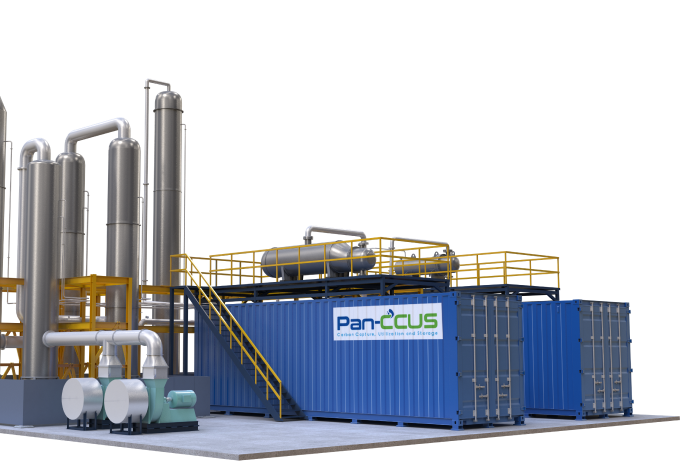
Onshore regulations
the core of the 2050 decarbonization policy
In order for Korea to achieve the goals set forth in the Paris Agreement, it was argued that technological development as well as the overhaul of the law, institution, and implementation system were urgently needed. As a follow-up measure, the implementation organization of the emission trading system (offset system) promotion system, which had been in effect since 2015, was reorganized.
In the greenhouse gas emissions trading system, the government assigns greenhouse gas emission rights on a yearly basis to businesses that emit greenhouse gases so that they can emit greenhouse gases within the allocated range, evaluates the actual greenhouse gas emissions of these allocated businesses, and allows transactions between businesses for emission rights.
-
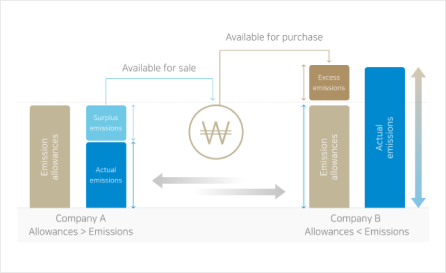
Concept of emission trading system
-
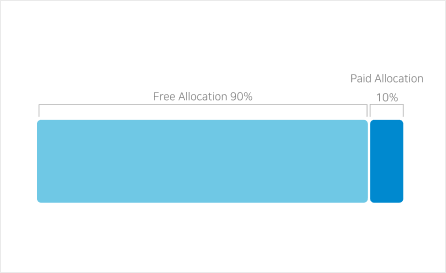
Allocation of carbon emissions
for the 3rd plan period (2021-2025)
- Strict limits on emissions
- The government sets clear greenhouse gas reduction targets
and allocates emission allowances to each economic entity
participating in the emission trading system. - It provides a predictable emission path by accounting for gradually
decreasing total emission allowances, thereby sending a long-term
market signal to companies and investors.
*Korea's carbon credit trading system has been in effect since January 1, 2015 in accordance with the “Act on Allocation and Trading of Greenhouse Gas Emission Permits” (May 2012), which
was enacted pursuant to the Article 46 of the “Framework Act on Low Carbon, Green Growth (January 2010)”
- Alternatives to onshore regulations
-
01
Trading of carbon credits
-
02
Transition to green fueled power plants
-
03
Installation of CCUS Carbon Capture Utilization and Storage
- PANASIA's on-shore carbon neutral solution


We seek creative challenges
with our infinite passion for
eco-friendly technologies.


- Panasia About Eco-friendly Solution MRO Customer Support Media ESG
-
Address
55 MIEUMSANDAN 3-RO,
GANGSEO-GU, BUSAN, KOREA
(46744) -
Tel 051 831 1010FAX 070 4369 3701
- Contact Us
COPYRIGHT@PANASIA CO.,LTD. ALL RIGHT RESERVED
